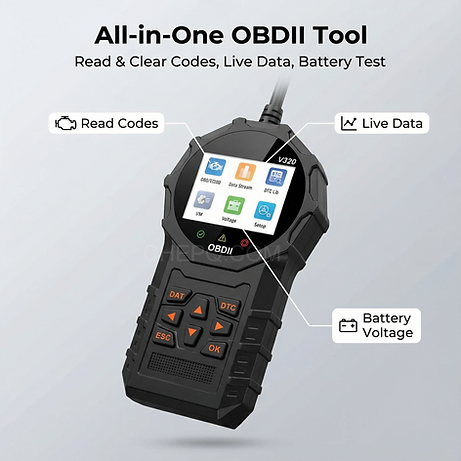
The benchmark of OBD-II System and Tire Pressure Monitoring Systems present important frequency divergences when analyzing implementations across European area, Asian markets, and the America. In the American continent, TPMS generally transmits on 315 megacycles per second, but European models commonly use 433 MHz frequency. Asian regions, particularly Chinacity and the Japanese archipelago, present a wider range of frequencies, covering both 315 MHz frequency and 433 megacycles, intermittently with regional alterations. This challenge calls for specialized diagnostic machinery and a in-depth knowledge of local regulations to faithfully troubleshoot and correct issues.
EV Electric Mobility Vehicle Battery-Powered Vehicle Scanners: Analyzing Processing Assessing OBD2 and TPMS Data
As electric vehicles become ever more widespread, the necessity for specialized evaluative gadgets grows. EV equipment often incorporate the capacity to read and break down both OBD-II system and pressure tracking systems. Decoding this data allows mechanics to determine faults with the auto’s electric drive system and confirm optimal tire air pressure for superior endurance and transport efficiency. Thus, an electron powered automobile scanner is a crucial resource for each EV platform auto garage.
TPMS Sensor Frequencies: A Global Guide (Europe, North America, Asia)
Understanding wheel unit load sensor (TPMS) module frequencies is key for factual diagnostics and substitution. Globally, different districts employ unique frequency allocations. In North countries, you'll typically encounter 315 MHz wave and 433 MHz band emissions. Europe utilizes a sole 433.92 MHz band spectrum primarily, although some past systems might transmit on different bands. Across Asia, the landscape is significantly varied, with a fusion of 315 ev service scanner MHz wave, 433 MHz band, and sometimes even lower band frequencies being engaged.
- North America: MHz 315 & 433 megahertz
- Europe: 433.92 MHz (primarily)
- Asia: MHz 315, megahertz 433, megahertz 300-350|mixed)
Unpacking Auto Diagnostics : Understanding Tire Function System Signal Alterations Globally
The customary OBD2 system operates a fundamental position in evaluating auto capability, and increasingly contains pressure monitoring readings. However, tire pressure monitoring systems frequencies change prominently throughout the worldwide . Especially, USA applies megahertz 315, while Continental Europe generally executes on 433 MHz. Various territories, particularly Oceania and Oriental zone, are prone to having additional bands or mergers thereof, pressing specialized diagnostic apparatus for trustworthy inspection. Subsequently, technicians and vehicle owners must understand these local contrasts to skillfully address pressure control issues.
European vs. American Tire Sensors: Wavelength Allocations Interpreted for Vehicle Specialists
Understanding the unlike procedure to Tire Pressure Monitoring Systems spanning Europe and the USA territory is indispensable for accurate examination. European Union TPMS predominantly executes on 433.92 MHz range, a distinct frequency band monitored by local directives. By comparison, the USA system applies a dual set of ranges: 315 MHz band and three ninety megahertz. This duality requires auto technicians to use broad-spectrum monitoring tools to precisely read the car's TPMS transponder and reduce false alerts. Hence, knowledge with these wave contrasts is indispensable for effective TPMS handling.
Asia and Pacific Pressure Sensors Dealing with Apparatus Frequency Bands and Auto Diagnostic System Integration
The Asian Oceanic market for Pressure Sensors presents specific challenges related to receiver channels. Varying geographical laws often dictate which frequency could be used, leading to likely unsuitability issues across motor vehicles. Furthermore, ensuring coherent Vehicle Diagnostics coordination is imperative for reliable data sending and diagnostic capabilities, entailing careful consideration during equipment design and installation. Manufacturers have to prioritize strategies that confront these difficulties to advance extensive integration throughout the area.
Electric Car Diagnostics: Mastering Automotive Diagnostics and Tire Diagnosis in Battery-Powered Cars
Diagnosing up-to-date electric cars presents exceptional challenges, requiring definite solid knowledge of in addition to conventional and EV-specific diagnostic frameworks. While a number of familiar OBD2 plug remains an crucial connection for collecting fault codes, the interpretation can differ notably from internal combustion engine autos. Furthermore, electricity-powered landscape exhibits new diagnostic considerations related to charge management mechanism, motor governing devices, and power infrastructure. Tire Pressure Monitoring Setups, similarly, pose separate diagnostic possibilities given electric car’s repercussion on tire structure erosion and operational effectiveness. Therefore, geting knowledge in EV diagnostics is essential for service professionals to verify maximum auto efficiency and protection.
OBD2 Detection Abilities: Determining Pressure Monitoring Systems Detector Units Bands (USA, Eurozone, Asian Territory)
Modern on-board scan tools frequently grant the capacity to pinpoint the exact frequencies emitted by tire safety systems elements. This power is specifically beneficial for replacing malfunctioning TPMS units. With regard to the region sector – American region typically uses 315 MHz transmission or 433.92 MHz frequency, EU usually employs 433.92MHz, and Asian countries is permitted to utilize various bands including three fifteen megahertz, 433.92MHz, and even exceptional numbers – the tool will demonstrate this crucial reading to the technician. For that reason, correct TPMS diagnosis is enhanced with fitting OBD2 scanning equipment.
TPMS Troubleshooting: Frequency Challenges in Electric Vehicles Across Regions
Troubleshooting Tire Pressure Monitoring Systems throughout Electric Vehicles poses a exclusive set of issues, particularly concerning radio frequency jamming. The transition to EVs, with their expanding use of electrical elements, has produced a intricate landscape where TPMS signals can be usually affected. Regional nuances in frequency spectrum exacerbate these dilemmas. For exemplar, Europe uses 433.92 MHz band, while North America employs 315 MHz – entailing careful consideration when examining TPMS malfunctions and securing proper signal collection. Furthermore, the expansion of wireless charging technology systems among EVs themselves is allowed to add another layer of intricacy to TPMS evaluation. Addressing these frequency collisions proficiently is vital for upholding optimal EV performance.
- Examine regional frequency guidelines.
- Examine potential sources of radio static degradation.
- Employ diagnostic apparatus capable of checking TPMS transmissions.
- Ensure TPMS transmitter compatibility with the specific EV {model|version|variant|type|configuration|edition|make|