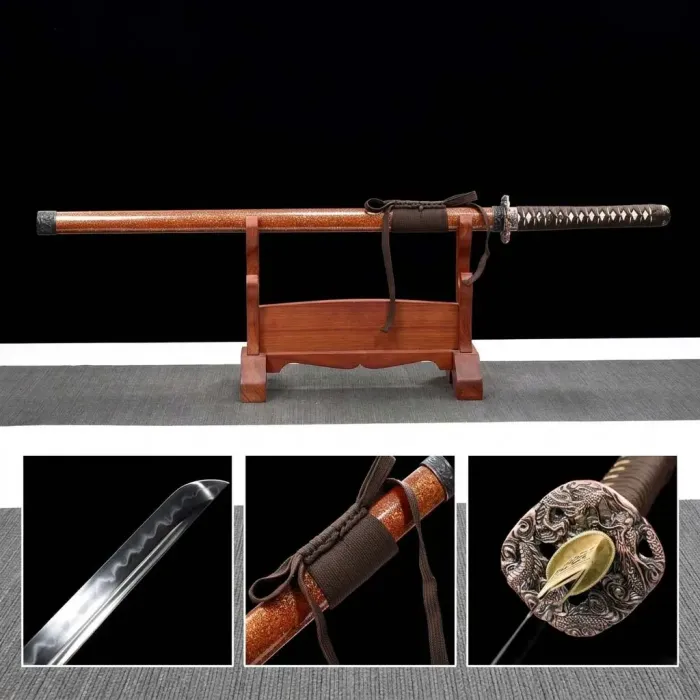
Such customary eastern blade serves as a impressive example of fabrication, but how about you strive for to show your own style? Adjusting your gear is a rewarding journey, allowing you to build a truly distinctive piece. From the haft wrapping and habaki to the protector design and hamon, each component offers a chance for personalization. This examination delves into the field of katana alterations, providing knowledge for both rookies and seasoned enthusiasts aiming to inscribe their impression on the time-honored art of the samurai.
Primary Genuine Workmanship
For starters eager to embark on the fulfilling journey of historical swordplay, 1060 steel katanas offer an outstanding entry point. This chosen grade of fundamental steel strikes a nice compromise between value and excellence . While lacking compared to hard as premium steels, 1060 permits a acceptable level of knife work , making it tailored to initiates to improve the fundamentals of katana upkeep and enjoy the charm of original Japanese weaponry. It’s a superb choice for fostering experience without the fiscal burden of more premium steels.
T Gear Steel Weapons : Managing Efficiency and Budget
Enabling fans seeking an authentic weapon experience without surpassing the finances , T10 compound katanas represent a favorable option. These blades offer a noticeable improvement in toughness compared to lower-grade alternatives, exhibiting reasonable edge retention and fair flexibility for initial hacking techniques. While not rivaling the excellent characteristics of elite steels like T100 or folded alloy , T10 provides a remarkable blend of power and budget-friendly nature , making them a sought-after choice for novices and those on a tight income .
Going past the Keel : Adapting Your Cutting Weapon's Fittings and Grasp
Whereas the sharpened blade is undeniably the important point of a katana, truly amplifying its aesthetic lies in the exact customization of its details and handle . This process allows craftsmen to reveal their unique design . Explore the sweeping possibilities: menuki - decorative ornaments that enhance visual beauty ; the hamon sleeves – often exquisitely crafted ; the tsuka foundation itself, wrapped in genuine ito string ; and the fusa knob , which can be crafted from various resources like gold or cartilage .
- Choose subjects that align with you.
- Evaluate with diverse composites .
- Focus on strength for a enduring mark .
The Fascination of the Katana: Origins, Mastery, and Material
Each Japanese sword contains a matchless allure, steeped in epochs of Asian history and tradition . More than merely a implement of military action , it's a symbol of the bushi ethos – a fusion of dexterity and rule. Its evolution spanned multiple generations, with early cutting tools evolving into the graceful curvature and efficient edge we perceive today. The production involved is truly remarkable , requiring lifetimes of mentoring to become skilled in . The process involves a multifaceted folding of steel bloom , creating layers that boost the edge’s flexibility and shaving ability. Different schools of metalworking originated , each with their distinctive secrets and practices for achieving the flawless balance and definition - a truly challenging pursuit.
- Former Katana designs
- The role of the nihonto in fighter culture
- Heritage metalworking processes
Deciding the Appropriate Steel for Your Bladed Weapon Project: 1060 vs. T10
Opting for the right steel is remarkably important for any katana project, and the determination between 1060 and T10 can be intricate. 1060 is a popular American fabrication, offering a respectable balance of robustness and fortitude, enabling it moderately easy to handle. However, T10, a Nipponese steel, commonly boasts enhanced wear longevity and can possibly achieve a higher final hardness, although it can be relatively laborious to control and requires meticulous heat conditioning. Consider your expertise and intended outcomes: for a learner, 1060 may be a more straightforward launchpad, while the proficient smith might favor the increased details of T10.
- Facility of Managing
- Surface
- Final Stiffness
Discovering Power: Refined Katana Adaptation Practices
Mastering the art of katana alteration extends far beyond basic buffing. Serious smiths are now researching advanced techniques to truly unleash a blade's hidden potential. This includes intricate work with the temper rim, utilizing specialized elements for differential hardening and carefully electing the shape of the crossguard to optimize balance and capability. Beyond purely functional alterations, artisans are increasingly focused on generating unparalleled aesthetic grace, through complex embossing and layered polishes that truly transform a katana into a work of art.
From Raw Steel to Masterpiece: Crafting a 1060 Katana
The journey opens with ordinary 1060 compound , a tough material far separated the refined katana it will turn into . Skilled bladesmiths apply a multifaceted process of layering and forming the raw steel, repeatedly burning it and flattening it to discard impurities and build a uniform grain structure. This exhausting process, often going on for months , builds the imperative strength and elasticity characteristic of a original Japanese blade . Continued heat manipulations , including accurate katana sword hardening and cooling , are mandatory to achieve the desired harmony of sharpness, permanence and magnificence.- Layering: Minimizes impurities and constructs grain structure.
- Constructing: Forms the steel into the initial blade form.
- Annealing: Establishes the final hardness and flexibility.
The Perpetual Attraction of the Katana: Extensive Study of Steel and Alteration
Such long-standing katana survives a striking symbol within Japanese tradition , its attraction far overtopping mere arms and armor . Forged from traditional steel and often featuring intricate patterns , the technique of creation itself is a respected art. Beyond the primary craftsmanship, the ability to tailor a katana - from the quench mark to the haft wrapping and fitting - affords for a honestly individual demonstration for both worshippers and followers alike. This amalgamation of tradition-rooted steelwork and boundless personalization creates the katana's continued widespread acceptance across the realm .